THE WRITING HOUSE METHOD
The Next Right Step
A Practical Philosophy for Building a Life
EMILY ENGLISH
Founder
VERSION 1
INTRODUCTION
Why Large Dreams Feel Overwhelming
Most big dreams don't collapse in some dramatic way. They just get too heavy to carry through an ordinary day, and eventually you stop picking them up. What once excited me can, over time, turn into a weight I'm dragging around instead of a reason to get up.
I've wanted to write a book for years. At one point I wanted to leave a perfectly stable job for something that scared me a lot more. Lately it's been building a life around work I actually care about, rather than whatever happened to be available that year. Every one of these showed up the same way: as a finished picture, no instructions attached. Living in Spain. A manuscript I could be proud of. An organization that, at the time, was nothing but a name in my head. I could see all of it clearly. I had no idea how to get there.
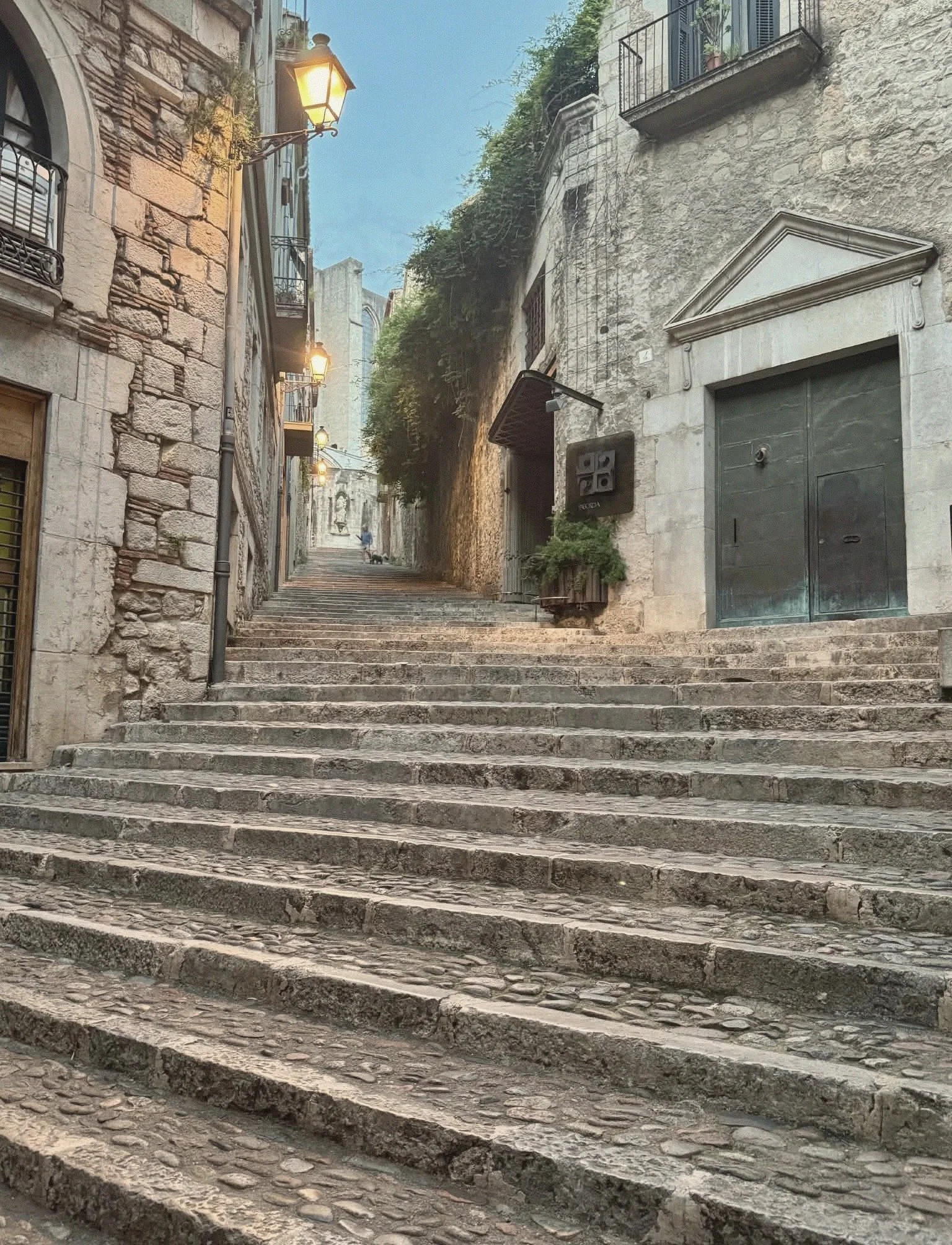
When I can't see the whole staircase, my first instinct is to assume it doesn't exist. That the people who get big things done must have some clarity, or nerve, or certainty I just don't have.
I don't think that anymore. Most of the meaningful lives I've watched up close weren't built by people who saw the whole path. They were built by people who took the next visible step, then stood there for a minute until the one after it came into view. This became a usable tool in my everyday life.
THE QUESTION
What Is the Next Right Step?
For the past several years, one question keeps pulling me back more than any other: what's the next right step?
Not the final step. Not the best possible step, or the one that guarantees things work out. Just the next one. The smallest true movement I can actually find from where I'm standing, not from the place I wish I'd already reached.
Honestly, this question has moved my life further than any five-year plan I've ever written. Five-year plans are mostly fiction, in my experience. Educated guesses dressed up as commitments, written by someone who can't yet know what she'll learn along the way. Asking what's next asks for something smaller. Not a forecast. A decision, made with whatever I actually know right now.
It's a modest question to build a life around. But it's also the only one I've found that reliably gets things built.
THE METHOD
Six Steps
I can describe the practice in a few lines. That doesn't make it easy; simple and easy are different things. Here's how it works:
01 Begin with the Vision
I start with some sense of where I'm headed, not a blueprint, just a direction. Living in Spain, say, or a finished manuscript, or an organization built around what I actually value. The vision doesn't need to be precise. It just needs to be true enough to walk toward.
02 Make the List
Then I write down everything that might somehow get me closer to it, like everything I can think of. No order, no filtering for whether it's realistic, I just get it out. Half of it turns out to be unnecessary. Some of it is years away. That's fine, the point isn't efficiency. It's getting the ideas out of my head and onto paper, where they stop crowding each other and start looking like actual choices.
03 Identify the Next Right Step
From that list I pick whatever's actually available to me right now. Not the most important item, not the most impressive sounding one. Just something I could realistically start today or this week. It's almost always smaller than I want it to be, closer to 'write the mission statement' than 'launch the organization.' I used to think that meant I was thinking too small. Now I think it's just how ambition survives an ordinary week.
04 Take the Step
Then I actually do it. Just the one step, done as well as I can manage in the time I actually have that day. It doesn't take much talent. It takes willingness, which is a different muscle entirely. I understand that it is important to carefully make big decisions, but I think sitting there thinking about it, not doing anything is about the worst option.
05 Reevaluate
Once the step is done, I stop and look at it honestly. Did it move me closer, or did it just feel like motion? Sometimes the next right step is obvious from here. Sometimes the whole list needs adjusting, because the step itself taught me something the list didn't know yet.
06 Repeat
And then I do it again. Honestly, at this point it's less a method than a habit, and it's surprising how much ground a habit covers if you just keep at it.
A CLARIFICATION
What This Method Is Not
This isn't a productivity system. It has nothing to say about your morning routine or squeezing more output out of your hours, and I'm not interested in efficiency for its own sake. It's fine to fail. Just try to fail while you're still moving toward where you're headed, not sideways from it.
It's not a hack, either --- there's no shortcut hiding in it, no trick that shrinks large work down. The work stays exactly as big as it is. All that changes is how much of it you have to look at in one sitting --- which is what makes it deliberate instead of accidental.
It's not a guarantee, either. Following it faithfully won't promise a particular outcome, only a particular kind of progress: the kind that comes from moving instead of waiting until you feel ready.
And it's not a replacement for having a vision in the first place. The next right step only means something if there's a direction worth walking in. Without that direction you're just moving. With it, you actually get somewhere.
THE FOUNDATIONAL BELIEF
Why the Method Works
Here's the belief underneath all of it: clarity usually follows action, not the other way around, even though I keep catching myself expecting it to work the other way around.
Most of us wait to feel certain before we'll let ourselves begin. We want to feel sure before we commit, clear on the whole path before we take a single step onto it. That kind of clarity almost never shows up first, though. It gets produced. A byproduct of having tried the thing and found out, firsthand, what the trying actually revealed.
I don't think I've ever built anything large through a large action. It's always been a long string of small, deliberate steps, done consistently enough that from a distance it ends up looking like a leap.
The leap only looks like a leap to people who weren't there for the steps. That's where the actual accomplishment happens, in the steps nobody was watching.
IN PRACTICE
The Writing House Example
The Writing House didn't show up fully formed. It started as a question, asked pretty honestly, one ordinary evening: what would it actually look like to build a life on purpose?
From there the steps were small, and at the time they didn't feel like much. I wrote a mission and a set of values and argued with myself over the wording until they felt true instead of just tidy. I drafted the manifesto section by section, reading each part back to check whether it sounded like conviction or just performance. There was an embarrassing amount of time spent boiling one guiding rule down to a single sentence, then a bio written four different ways for four different rooms. I tried logo after logo, most of it not working, until I finally asked for help. Got an email address. Bought a domain name on an ordinary Tuesday, for reasons that felt more hopeful than certain at the time.
None of it required knowing how the whole project would turn out. Each piece just required knowing what came next. Looking back, it resembles a plan. At the time it was just the next right thing, over and over, a page at a time.
HOW THEY WORK TOGETHER
The Rule and the Method
The Rule and the Method aren't the same tool. I use them together, but they're doing different jobs.
The Rule is a question about direction: does this help build the kind of life I actually want? It tells me whether something belongs in this life at all. It helps me keep taking steps in the right direction. And on the days I fail, it at least tells me whether I failed while still headed somewhere or failed sideways.
The Method is a question about motion: what's next? It's how I actually move, once I already know the direction.
I've watched so many large, and small things, fail from missing either one of these. Pointed the right direction but never acted on. Or moving fast toward something that was never actually worth reaching.
It doesn’t work without both.
FOUNDER REFLECTION
In My Own Words
Over the last several years I've learned to meet change by asking one simple question: what's the next right step?
I write the list. I figure out what's doable right now. I'm honest with myself, and I do it. Then I look around again.
Every time, clarity shows up after I've acted. Almost never before.
I'm not trying to see the whole path. I'm just trying to keep moving toward a life I actually chose.
— Emily English
CLOSING THOUGHTS
The Next Right Step
There's no version of this work that will ever feel fully ready to begin. I used to think that was a problem to solve before starting. It isn't. It's just what beginning actually feels like.
It was never built by seeing the whole staircase. It was built one step at a time, by someone willing to take the next visible one and trust the one after it would show up when it needed to. That's the whole method. It's enough.
THE FRAMEWORK, IN BRIEF
The Rule
Does this help create a life of meaningful work, flourishing relationships, and lifelong curiosity?
The Method
What is the next right step?
Vision — List — Next Step — Act — Reevaluate — Repeat